

Can This Forgotten Medium Be Saved Before It Disappears?
Before VHS and PowerPoint, filmstrips were a classroom mainstay. Now one archivist is racing to save them from dumpsters, chemical decay, and oblivion.

The familiar Scooby-Doo theme song plays. BEEEEP. Velma and Scoob arrive at Shaggy’s house to bring him along for a fun day on the beach. BEEEEP. But Shaggy isn’t answering his doorbell! BEEEEP. He refuses to go to the beach because he has acne. He’s even wearing a paper bag over his head! BEEEEP. Velma drags Shaggy to a dermatologist’s office so he can learn about skin care. BEEEEP. Shaggy and Scoob study a chart that diagrams the layers of the dermis. BEEEEP. Velma answers Shaggy’s questions about how blackheads form. BEEEEP.
[synopsis of “The Scooby-Doo Gang in ’Skin Deep’ Part 1: What is Acne?”]
For most Gen-Xers and Boomers, that distinctive BEEEEP instantly conjures memories of classroom filmstrips. The medium was the go-to instructional format for decades, combining recorded audio with a series of still images projected onto a screen. When you heard that unforgettable chime, you knew it was time to advance to the next image.
“Practically every American who went to school between 1950 and 1990 saw them,” says Mark O’Brien, a filmstrip archivist. He notes that the medium’s main rival, the 16mm film projector, was far more expensive and technically complex, requiring a tech-savvy teacher (or a member of the A/V Club) to operate. “But manual filmstrip projectors had no automatically-moving parts, and just one knob that moved it along,” he says. “You could have a student operate it.”
Anyone accustomed to 24 frames per second may find it jarring to linger on a single still image for fifteen or twenty seconds while the soundtrack plays. And the production values in filmstrips can be wonderfully clumsy, stilted, creepy, and downright bizarre. But they documented the mundane assumptions of twentieth-century America in a way almost no other medium did, preserving how people learned, how businesses sold, how churches evangelized, how schools talked about sex, health, race, dating, insurance, journalism, and science.
Today filmstrips are so obsolete and unappreciated that many schools simply throw them away. Those that survive are often chemically degrading beyond recovery.
One of the only people trying to save them is Mark O'Brien. He created Uncommon Ephemera, which is dedicated to preserving and restoring this vanishing format. “Filmstrips have been systemically marginalized,” he says. “I’m the only person saving them at scale.”
I asked him to tell me about some of the most memorable highlights from the 1,300 filmstrips he's preserved—including that Scooby-Doo lesson on acne.
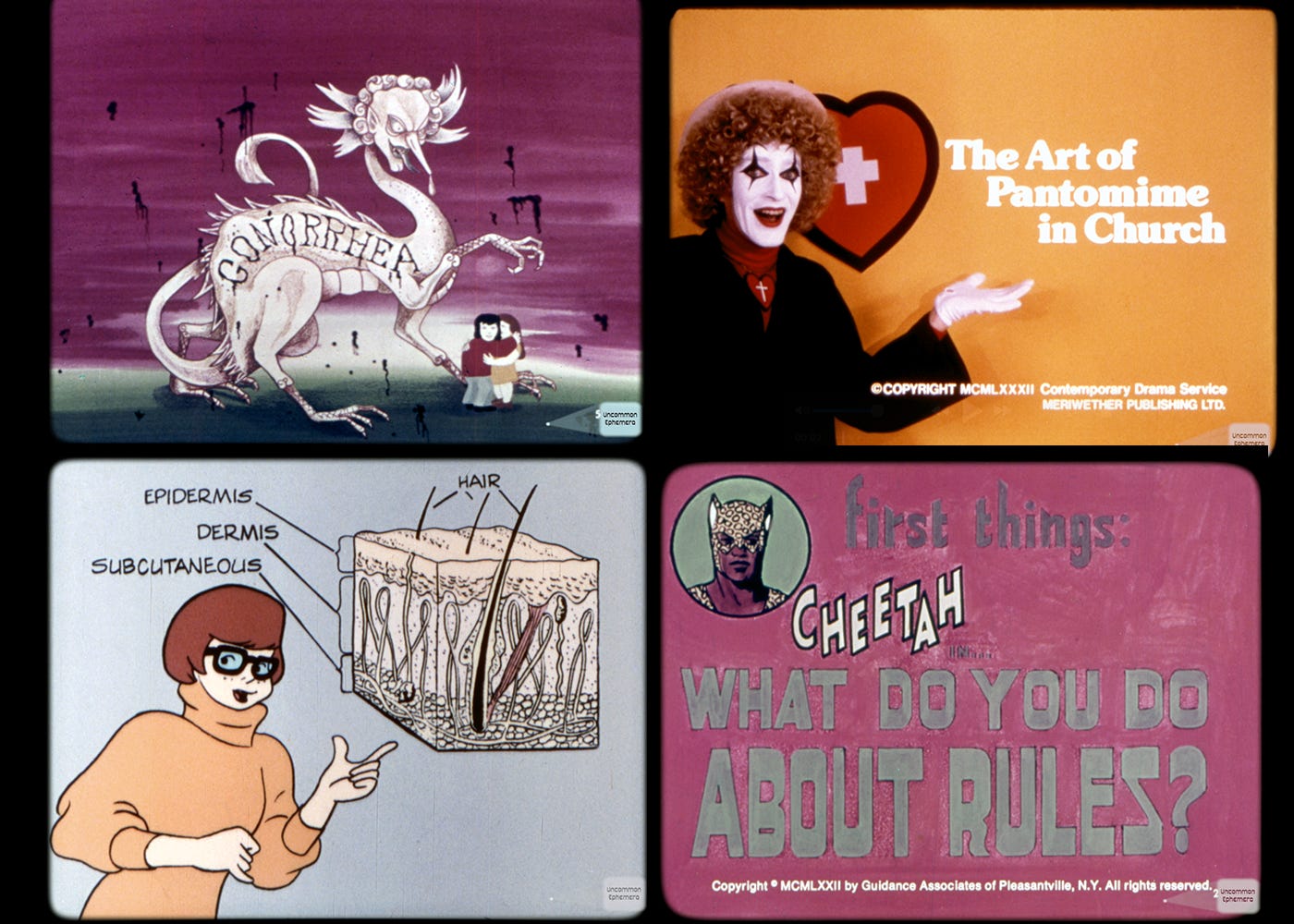
Historically important and highly weird: highlights from the Uncommon Ephemera archive
“Without filmstrips, our memory of American culture in the 20th century would be severely lacking,” O’Brien wrote in an essay for The Internet Archive’s Vanishing Culture series. “And they’re fun! Full of anachronism, awkward photography, non-theistic proselytizing, and so much incredible hand-drawn artwork that runs the gamut from gorgeous to insane to psychedelic to ‘my three-year-old drew this.’”
“I’ve restored several that are truly awesome and represent some of the quirky ways the format was used. Here are a few highlights, in no particular order, that show the breadth of topics and use cases of filmstrips. ”
“How to Get Gonorrhea” (1974) (Excerpt above, full clip at link. NOTE: The companion filmstrip “How to Get Syphilis” can be viewed here.)
This title makes it sound like an instructional guide to catching gonorrhea, but it's really a wonderfully unhinged slice of mid-1970s sex education. It has a funk soundtrack, spectacularly bizarre artwork—including gonorrhea rendered as a five-headed monster and a pus-dripping dragon—and the same awkward photography and desperate attempts at coolness that defined so much educational media of the era.
Because schools discarded them once the information became outdated, filmstrips on sex education, home economics, and social skills—which are among the most revealing today—are now exceptionally rare. — Mark O’Brien
“Cheetah in… ‘What Do You Do About Rules?’” (1972) (Excerpt from Part 1 above, full clip at link. Part 2 of this filmstrip can be viewed here.)
Most entries in the series used semi-professional photographers and live actors. The two Cheetah installments instead became comic books illustrated by Gray Morrow, the Marvel/DC artist who co-created Man-Thing—an unusually direct collaboration between educational publishing and mainstream comics. Morrow died in 2001 so we may never know how that partnership came about. —Mark O’Brien
“The Scooby-Doo Gang in ’Skin Deep’ Part 1: What is Acne?” (1980) (Excerpt above, full clip at link. Part 2 is here.)
Hanna-Barbera was one of a few mainstream entertainment companies who leaned into filmstrips. In the late 70s through the early 80s they produced dozens of exclusive titles for sound filmstrip, with their characters and sometimes their voice actors as well. In “Skin Deep,” Shaggy is voiced by Casey Kasem, while Don Messick returns as Scooby. Velma is played by a different actor from the cartoons, but still walks viewers through acne prevention under the guise of helping Shaggy overcome his embarrassment. Hanna-Barbera produced filmstrips using characters from Scooby-Doo, The Jetsons, The Flintstones, Jabberjaw, The Banana Splits, and more. (Though the remaining Banana Splits ones are all in the hands of private collectors who won’t give up a few copies for preservation…) —Mark O’Brien
“The Art of Pantomime in the Church” (1982) (Excerpt above, full clip at link.)
This features well-known mime Randall Bane, who was also a proud Christian. It immediately strikes you as “here are two things that nobody asked anyone to put together.” Bane performs his pantomime routine “Christ and I Love You,” goes over a pre-mime stretching routine, and then does a demonstration of how a pantomime group in a church viewing the filmstrip might bring the Book of Psalms to life. I’m not at all anti-Christian, but I’ve always been fascinated by their attempts at art and culture in the modern era and how unintentionally goofy it is.—Mark O’Brien
“While You Can” (1973) (Excerpt above, full clip at link.)
Elba Systems made customizable insurance filmstrips that agents could present in clients’ homes using a projector built into a briefcase. Unlike classroom filmstrips, these advanced automatically via a low-frequency cue, producing smoother timing than the familiar classroom beep.—Mark O’Brien
“’65 Service Roundup” (1965) (Excerpt above, full clip at link.)
Once a month Chrysler would produce a sound filmstrip for dealership service departments with new information and fixes for their vehicles. For a long time, they featured an anthropomorphic wooden doll named “Tech,” who would talk mechanics through the new information. Classic car guys hoard these filmstrips because some of the information in them was never released to the public, making them valuable for the maintenance of old cars.—Mark O’Brien
A last-ditch effort to protect the filmstrip medium before it vanishes
In the 1990s, while doing IT work for a rural New York school district, O'Brien watched a library discard an entire wall of filmstrips. He convinced the librarian to let him rescue them.
He started to examine this haul, and digitize the audio as low-bitrate MP3s. He admits that his initial impulse was to make “angst-ridden, sample-laden music” out of the filmstrips. He also got friends together to poke fun at their cheesy anachronisms, in the manner of a Mystery Science Theater 3000 movie.
Some filmstrips of the Uncommon Ephemera archive have only had their audio preserved, like the patriotic series “The American in the Cold War.” (excerpt above, full recording in link.)
After a few years, O’Brien junked those filmstrips he had rescued. “These two atrocities— saving only MP3s instead of lossless audio, and throwing away the filmstrips, most of which I still haven’t found again — haunt me to this day,” he writes.
Two decades later, he checked to see what sort of preservation efforts were going on with filmstrips. He was horrified to discover that the answer was: nobody.


There actually are some organizations that are working to preserve educational films and videos. Filmstrips are another story. “Someone somewhere in an ivory tower decided that they would be excluded from every effort to save media for historical and cultural purposes,” says O’Brien.
He began buying filmstrips on eBay and experimenting with ways to digitize them on a shoestring budget. It quickly became clear, he says, that "this wasn't preservation so much as triage."


“Most filmstrips were printed on Eastmancolor, a film stock which is now notorious for self-destruction,” he writes. “First, the cyan and yellow dyes fade, destroying fine detail and leaving the film an intense shade of red. Then, the binder chemical that holds the dye layers in place begins to disintegrate. Once this happens, the dye layers move and smear, destroying the images on the film.”
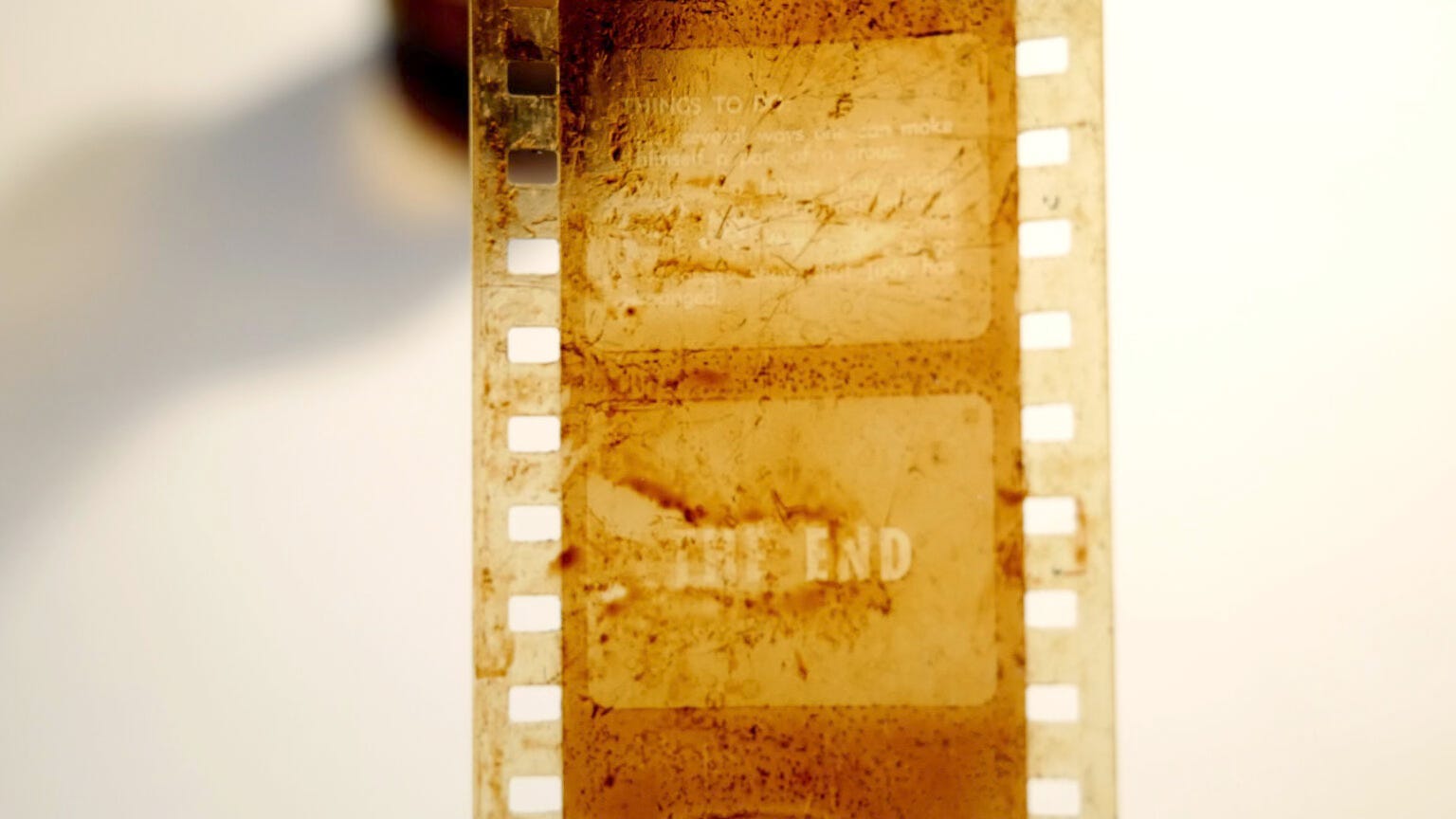
His solution was to cut the filmstrips into scanner-sized sections—a method that horrifies traditional archivists but lets him digitize material that would otherwise disappear. “They had thirty-plus years to digitize the format on the right equipment,” O’Brien says.
“They fill in countless gaps in our cultural history about how children were educated, how workers were trained, how a customer’s buying experience could be enhanced or manipulated. There’s a thousand little contextual reasons they were important.”
One example is “Going Steady” (1958), produced by the religious educational outfit Family Filmstrips (excerpt below, full filmstrip at link.) It’s a product of its time in some of its observations on relationships and gender roles, but surprisingly nuanced in some ways. “Going Steady belies contemporary expectations, hardly mentioning religion at all,” O’Brien notes.
O'Brien isn't backed by a museum or university. He's been unable to qualify for preservation grants, leaving him to fund much of the work himself—even driving DoorDash to keep the archive alive.
If you've ever wondered what happened to the strange instructional media that shaped generations of children’s minds, one man is trying to save it before it literally turns to dust.


O'Brien can't save this forgotten corner of American culture by himself. If you enjoyed this glimpse into the strange world of educational filmstrips, consider supporting his work. Browse the archive, remix the material, spread the word—and if you ever see a school clearing out old filmstrips, make sure they find their way into preservation rather than a dumpster.
You can support Uncommon Ephemera via GoFundMe, Patreon, or Venmo here. You can also follow it on Youtube, Bsky, Twitter, and Instagram.
The auto dealer filmstrips occupy a fairly large corner of Youtube. Some are smart and sophisticated, using a play-in-play format, like this Ford film.
https://www.youtube.com/watch?v=nY3wAVB_NJ4