

No one ever said “Just the facts, ma’am” on Dragnet. It originated in a parody.
The iconic catchphrase was never actually uttered on the show. It came from this fantasy-themed parody record.

Sometimes a popular media property is defined by one iconic line. If you grew up with a television in the monoculture era, you probably remember many of these:
“Everybody lies.”
“Make it so.”
“Whatchoo talkin' 'bout, Willis?”
“Just one more thing...”
“Dy-no-mite!”
“De plane! De plaane!”
“How you doin'?”
But here’s the thing: some of the most famous lines in pop culture were never actually said at all.
Humphrey Bogart never said “Play it again, Sam” in Casablanca.
Tarzan never said “Me Tarzan, you Jane” in the novels or films.
No one on the original Star Trek series ever used the phrase “Beam me up, Scotty.” (For that matter, Bones McCoy never said “He’s dead, Jim.”)
Sherlock Holmes never said “Elementary, my dear Watson” in Arthur Conan Doyle’s stories.
The most interesting example is “Just the facts, ma’am,” from the pioneering police procedural Dragnet. The quote is synonymous with the show, and has become a shorthand for any example of an emotionless no-nonsense style of speaking. But the line was never spoken on the show.
The actual source of the quote is a fantasy-themed parody of Dragnet that was incredibly popular when it appeared in 1953, but is virtually forgotten now. This is the story of how Dragnet got its phantom catchphrase.

Jack Webb created Dragnet and starred as LAPD detective Joe Friday, insisting on a realistic, procedural portrayal of police work. Friday spoke in a clipped, matter-of-fact style, peppered with jargon—even referring to crimes by their California Penal Code numbers.
Each episode opened with Webb’s blunt narration—“This is the city: Los Angeles, California. I work here. I'm a cop.”—and a disclaimer that the story was true, with names changed to protect the innocent.
Detective Joe Friday was constantly questioning eyewitnesses, urging them to give a straightforward and opinion-free account of what they saw. And he was always polite, addressing people as “sir”and “ma’am.” But again, Webb never uttered the phrase “just the facts, ma’am.”
Dragnet started as a radio show in 1949, then became a TV series that ran until 1959. It returned for a few years in the late 1960s, giving Joe Friday a chance to grapple with the counterculture, drug culture, and rock and roll rebellion.
It can be hard to separate Friday’s gruff, rapid-fire delivery from what he’s actually saying: respect the law, obey authority, and stop tying cops’ hands with warrants and habeas corpus and the presumption of innocence. Dragnet shaped American society’s attitude towards law & order and civil liberties.
Here’s an atypical Detective Friday monologue from the 1960s revival of the show, in which he rails against Birchers and right-wing radicals. Dig his unique approach to line delivery.
The 1960s installment of the series was renowned for its campiness, juxtaposing square Joe with hippies slathered in blue paint. But the truth is that Webb’s flat, affectless delivery had always lent itself to parody, even in its first blush of popularity in the early 1950s. And that’s where the impressionist and comedian Stan Freberg comes into the story.
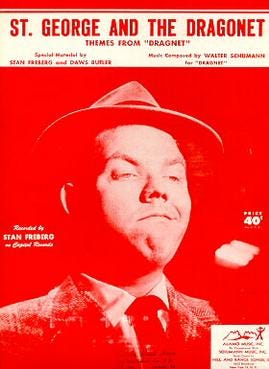
Long before the ill-advised 1987 film spoof starring Dan Aykroyd, Stan Freberg had already delivered a definitive parody of TV’s top cop. Released as a novelty single in 1953, it became the number-one record for four weeks, selling over a million copies.
“St. George and the Dragonet” featured an uncannily accurate imitation of Webb’s Friday voice, as well as his dense police jargon. But it recast the detective as a hard-boiled knight errant solving fairy tale crimes in a storybook kingdom. One who repeatedly and obsessively demanded “the facts, ma’am.”
The record’s massive popularity is what forever linked “just the facts, ma’am” to Dragnet. Webb was so delighted when he heard a pre-release version of Freberg’s track that he allowed the actual theme music to be used in it.
Here are a few excerpts tin which the catchphrase begins to take shape.
NARRATOR: The legend you are about to hear is true. Only the needle should be changed to protect the record.
ST. GEORGE: This is the countryside. My name is St. George. I’m a knight. Saturday, July 10th, 8:05 pm, I was working out of the castle on the knightwatch when a call came in from the Chief. A dragon had been devouring maidens. Homicide. My job: slay him.
As St. George questions witnesses, we hear the first variation on the catchphrase.
ST. GEORGE: 11:45 pm, I rode over the King's Highway. I saw a man. Stopped to talk to him.
KNAVE: Sure, I don't mind.
ST. GEORGE: What do you do for a living?
KNAVE: I'm a knave.
ST. GEORGE: Didn't I pick you up on a 903 last year for stealing tarts?
KNAVE: Yeah, so what, you wanna make a federal case out of it?
ST. GEORGE: No sir, we heard there was a dragon operating in this neighborhood. We just want to know if you've seen him.KNAVE: Sure, I've seen him.
ST. GEORGE: Mmm-hmm, could you describe him for me?
KNAVE: What’s to describe? You see one dragon, you seen ‘em all!
ST. GEORGE: Would you try to remember, Sir, just for the record?
ST. GEORGE: We just want to get the facts, Sir.
KNAVE: Well, he was, you know, he had orange polka dots...
ST. GEORGE: Yes sir.
KNAVE: Purple feet, breathing fire and smoke...
ST. GEORGE: Mmm-hmm.
KNAVE: And one big bloodshot eye right in the middle of his forehead. And uh, like that.
ST. GEORGE: Notice anything unusual about him?
Eventually, St. George’s committed fact-gathering helps him track down the dragon and bust him on a 502: Devouring maidens out of season.
The flipside of the record, “Little Blue Riding Hood,” did most of the work linking “just the facts, ma’am” to Dragnet in the public imagination. Freberg voices another detective knight, this one named Joe Wednesday, who’s investigating another fairy tale crime. “The story of Little Blue Riding Hood is true,” says the narrator. “Only the color has been changed to prevent an investigation.”
DETECTIVE WEDNESDAY: 11:45am, it happened. I saw a little girl in a blue hood carrying a basket. I stopped to question her. Pardon me, ma'am, could I talk to you for just a minute, ma'am?
LITTLE BLUE RIDING HOOD: What about?
DETECTIVE WEDNESDAY: Nothing much, ma'am. Just wanna ask you a few questions, ma'am. What's your name?
LITTLE BLUE RIDING HOOD: Little Blue Ridin’ Hood.
DETECTIVE WEDNESDAY: Where ya' going, ma'am?
LITTLE BLUE RIDING HOOD: Grandma's house.
DETECTIVE WEDNESDAY: Yes, ma’am. Whaddaya got in the basket?
LITTLE BLUE RIDING HOOD (defensively): Whaddaya trying to say, I got something in the basket I shouldn’t have?
DETECTIVE WEDNESDAY: No, ma’am, I didn’t say that.
LITTLE BLUE RIDING HOOD: Then whaddaya asking me all these questions for?
DETECTIVE WEDNESDAY: Just routine, ma’am, we just wanna get the facts.
DETECTIVE WEDNESDAY: May I have a look in that basket, ma’am?
LITTLE BLUE RIDING HOOD: Be my guest.
DETECTIVE WEDNESDAY: Let’s see. Sawed-off shotgun. Knife. Bludgeon. Box of dum-dum shells. Nothing suspicious here. All right, ma’am, we may want to talk to you later, so don’t leave the woods.
A more direct version of the phrase that would come to define the series Dragnet appears at the climax of this track, when the detective mounts a medieval sting operation.
[DOORBELL RINGS. DOOR OPENS.]
GRANDMA: Coming, dear.
DETECTIVE WEDNESDAY: OK, grandma, it's a raid.
GRANDMA (FEIGNING SURPRISE): A raid? Why, I’m just a peace-loving old lady, you’ve got the wrong grandma.
DETECTIVE WEDNESDAY: Yes, ma’am. We just wanna get the facts.
DETECTIVE WEDNESDAY: Where’d you get that bump on your head?
GRANDMA: The sky fell on me this morning.
DETECTIVE WEDNESDAY [VOICE OVER]: I made a note to book her on a 614 and turn her over to the psychiatrists. I tied her up, put her in the closet, then I put on the grandma suit and got into bed. [KNOCKING ON DOOR]
DETECTIVE WEDNESDAY: Come in, ma'am. [DOOR OPENS]
LITTLE BLUE RIDING HOOD: Hello, grandma, I got the loot. What're you doin' in bed?
DETECTIVE WEDNESDAY: I'm feeling poorly.
LITTLE BLUE RIDING HOOD: But grandma, what big ears you have!
DETECTIVE WEDNESDAY: All the better to get the facts. I just wanna get the facts, ma’am.
LITTLE BLUE RIDING HOOD: But gramma, what a big subpoena you have in your pocket!
DETECTIVE WEDNESDAY: All the better to serve you with.
LITTLE BLUE RIDING HOOD: But gramma, what a big .38 police special you have pointed at me!
DETECTIVE WEDNESDAY: All the better to take you in. You’re under arrest. You and your grandma are operating a goodies ring.
The Dragnet parody tracks got heavy radio play in October of 1953, and their chart-topping success led to quickie followup record from Freberg, “Christmas Dragnet.” In that one, Joe Wednesday investigates a man accused of 4096325-096704: Not Believing in Santa Claus.
A March 1954 cover profile of Jack Webb in Time magazine notes, “Phonograph records (St. George & the Dragonet, Little Blue Riding Hood, Christmas Dragnet) which parody Dragnet's terse, low-keyed dialogue have sold 1,326,000 copies, and Sergeant Friday's calm ‘All we want are the facts, ma'am’ has become a conversation staple.”
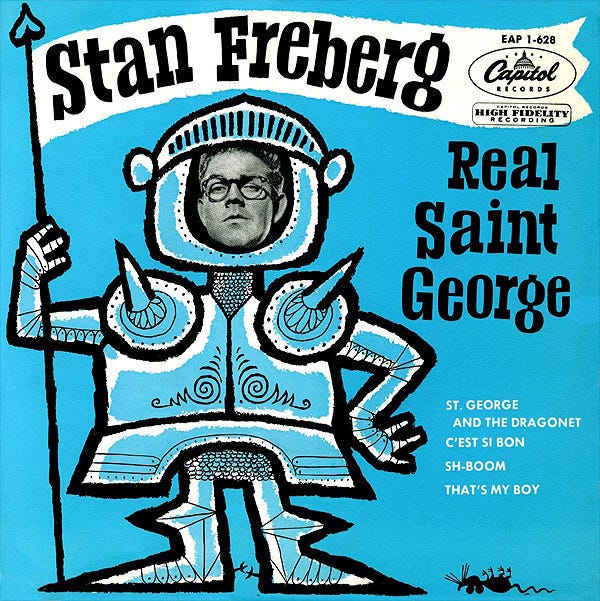
Sometimes a sharp but loving parody can get closer to the heart of a beloved property than the the thing itself ever did. Just as Galaxy Quest is the greatest Star Trek film ever made, Freberg’s novelty record is Detective Joe Friday’s finest hour.
ELSEWHERE:
Stan Freberg went on to be a very successful advertising guru who was famed for the irreverence of his TV spots. His campaign for Sunsweet pitted prunes, which reportedly boosting sales 400%, included this installment starring sci-fi luminary Ray Bradbury.
Stan Freberg also directed a massively successful series of commercials for Encyclopedia Britannica in the 1990s that starred his son, Donovan Freberg. The ads turned the snarky, bespectacled teen into a GenX icon.
Fans of campy celebrity vanity projects should check out should check out the album You're My Girl: Romantic Reflections by Jack Webb, which includes his robotic spoken recitation of the steamy love ballad “Try a Little Tenderness.”
Historian Owen Symes has a podcast series The Copagandists that explores the legacy of police shows. He devotes ten episodes to Jack Webb, culminating in this episode about the political impact of Dragnet.
Both Little Blue Riding Hood and her grandmother are voiced by June Foray, who was Rocket J. Squirrel in Rocky & Bullwinkle, as well as the Witch Hazel and Granny characters in the Warner Bros. cartoons, and an array of Disney characters. Foray is simply the greatest voice actor of all time. Cartoon director Chuck Jones famously remarked, “June Foray is not the female Mel Blanc. Mel Blanc was the male June Foray.” In addition to her prolific work, she was a leader in the animation community, and established the Annie Awards. Variety’s 2017 obituary is here.
Daws Butler, co-writer of “St. George and the Dragonet,” was an equally prolific performer who voiced the knave on the record, as well as Yogi Bear and a panoply of Hanna-Barbera characters. Joe Pace celebrates his portrayal of Cap’n Crunch on The Write House. Jon (Animated) sings the praises of Quickdraw McGraw and Undercover Elephant on Animated. Retroist champions Jinks the Cat.
Ahoy, Cap'n!
(Plus, I rather enjoyed Aykroyd's Joe Friday -though I was twelve at the time. And I adore Galaxy Quest, but Wrath of Khan is still the best Trek film. Oh - and to that point, The Orville is the best Trek since Undiscovered Country...)
Thanks for the nod!
Freberg transformed the comedy record in the same way Webb altered the format of police drama- they were both auteurs in their fields.