

The Reagan-Era Game That Feels Like It Was Made for 2026
This 1985 game simulated the long-term effects of a right-wing agenda. Four decades later, its dystopian vision feels prescient.

I first interviewed Steve Meretzky nine years ago about his trailblazing game A Mind Forever Voyaging for Glixel, a short-lived gaming portal launched by Rolling Stone. It was the first year of the Trump presidency, and it felt like an appropriate moment to explore the impact of this early attempt at an explicitly political game. Glixel’s site is down, and the game feels even more excruciatingly timely now. I’m posting an updated version of that article here, along with a new follow-up Q&A with Meretzky.
Perry Simm wandered the streets of his small Midwestern hometown bearing witness to the misery and deprivation all around him. As Perry passed a boarded-up museum, he remembered how the government had promised that the Plan for Renewed National Purpose, enacted three decades prior, would usher in a new Golden Age. Instead, that package of social and economic reforms had triggered a societal collapse.
Poverty was endemic. Jobs were impossible to find, and only the rich could afford medical care. The Border Security Force was ubiquitous, assaulting anyone who could not show proper ID.
The prison was well over its maximum capacity, now that any young person could be summarily sentenced on the suspicion of a violation of the Uniform Morality Code. “America First” trade policies and severe cutbacks in foreign aid had destabilized international relations. Vast consolidation of power in the executive allowed a quasi-fascist leader to treat any citizen he didn’t like as a terrorist.
The marquee above the movie theater touted new releases like Gutsplosion, Gringo Wars, and Let’s Kill Some Slants—popular culture reduced to simplistic bigotry and brutality masquerading as humor. The tech industry was scrambling to do damage control about a spike in suicides caused by “joybooths” that provided such intense neural stimulation that people lose touch with the real world around them.
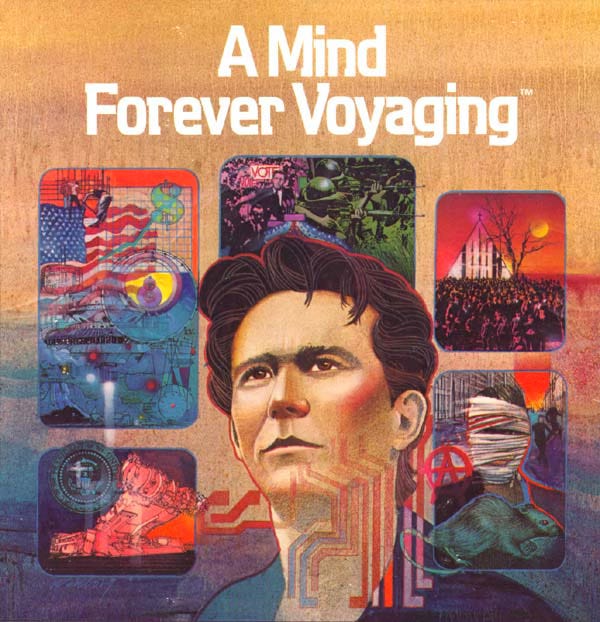
That’s a description of the game world of A Mind Forever Voyaging, an unprecedented computer game created four decades ago by Steve Meretzky. It was a text adventure, meaning that the story was told entirely through words. (The only images were the box art and the printed manuals and other materials that come with the floppy disc the game was stored on.) But it was one of the era’s most ambitious games.

The designer of the game was profoundly unhappy with the direction his country was heading. He felt that the Reagan administration’s economic policies, rhetoric, and crackdowns on civil liberties would all have terrible long-term consequences for America.
Meretzky had previously been known for the quirky humor and deviously clever puzzles in his work. But he wanted to try something different—something that had never been done before. He tried to express his political views through a bleak and somber science fiction narrative.
A Mind Forever Voyaging portrays the ruinous effects that a set of government policies had on a single town over the course of several decades. The game was released in 1985, the same year that Reagan took the oath of office for a second time after winning reelection by the most lopsided electoral college margin in history.

The game was a sales disappointment for Meretzky’s employer Infocom. It never the sort of cultural impact of other 1985 releases like Super Mario Bros, The Bard’s Tale, Ultima IV, or even Where in the World Is Carmen San Diego. At the time, didn’t even impact the political conversation.
But now, four decades after its release, A Mind Forever Voyaging is widely regarded as a trailblazing masterpiece. (If you want to check it out, Archive.org has a playable version available here.) Moreover, it offered a concrete example of how a game could deliver pointed social commentary at a time when few people thought games were capable of that. And it did so in a way that only a game could, letting players uncover its message by exploring its world and engaging with its mechanics and systems.
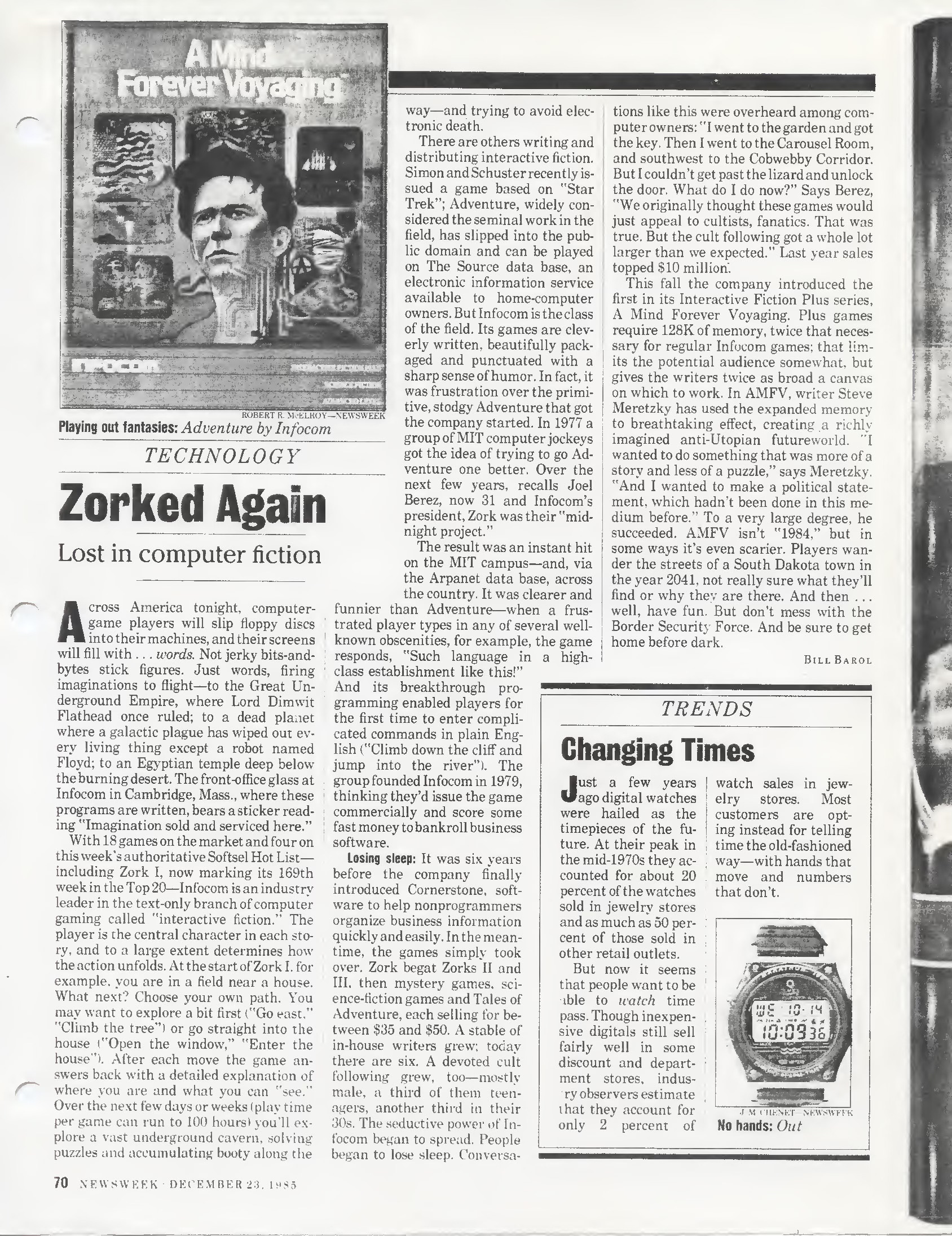
“I wanted to make a political statement, which hadn’t been done in this medium before,” Meretzky told Newsweek reporter Bill Barol at the time of the game’s release.
“To a very large degree, he succeeded,” declared Barol. “Writer Steve Meretzky has used the [game’s] expanded memory to breathtaking effect, creating a richly imagined anti-Utopian futureworld … A Mind Forever Voyaging isn’t George Orwell’s 1984, but in some ways it’s even scarier.”
THE GOLDEN AGE OF INTERACTIVE FICTION
The 1980s are often remembered as the dawn of the home video boom, the Decade of Greed, a second Gilded Age, the rise of the yuppie, the age of deregulation, the beginning of trickle-down economics, and the MTV era. But for many geeks, it was also the Golden Age of the text adventure. At a time when graphics were still rudimentary, text-only games offered some of the most sophisticated interactive experiences you could find.
Text-based games, which also went by the highfalutin name of “interactive fiction,” describe a setting and scenario for players with words. It’s up to the players to fill in the graphics in their heads. A text parser allowed players to type in simple commands and tell the game what action they wanted to perform and where they wanted to go.
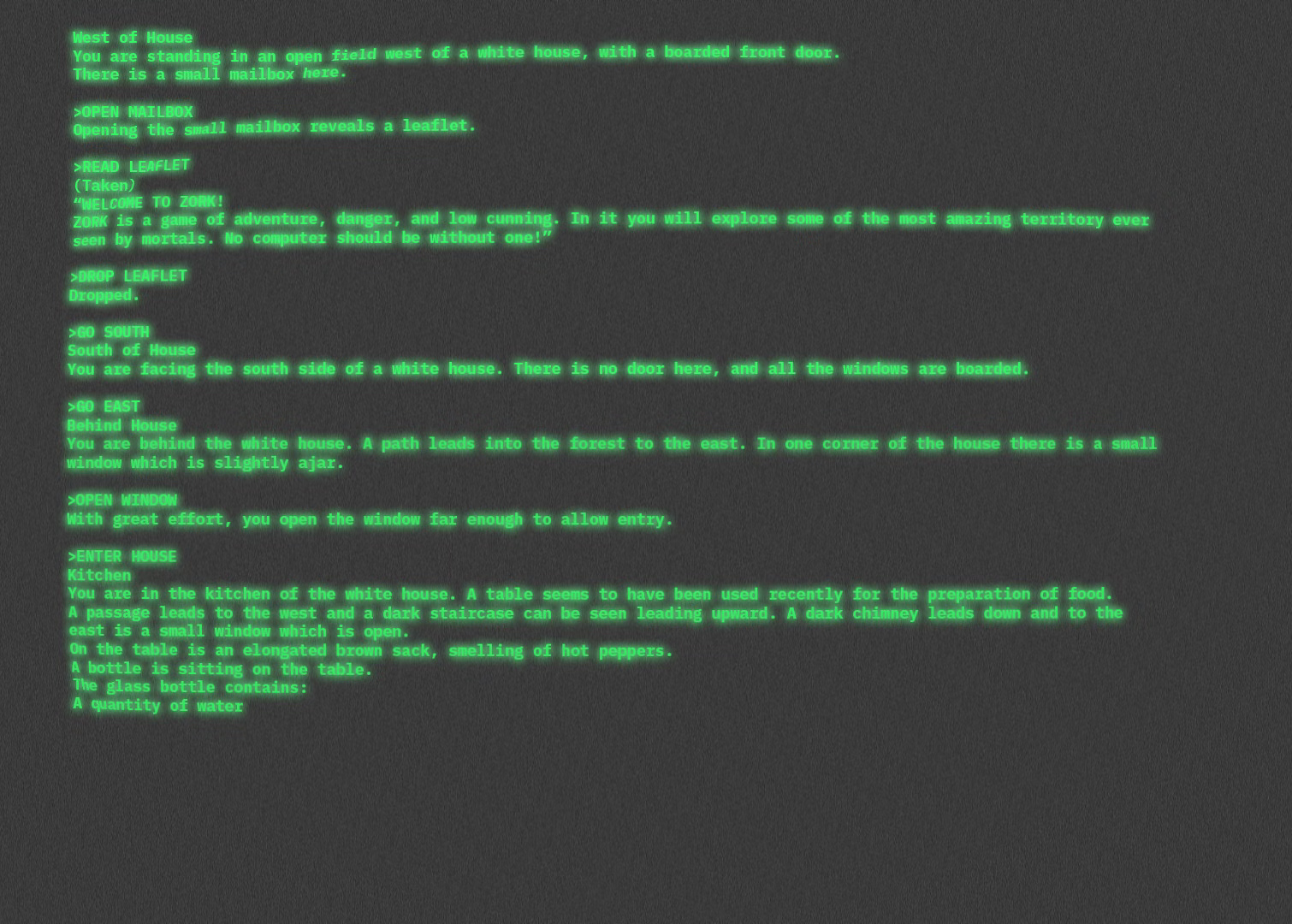
“In the early 1980s, speaking to your computer in plain English sentences seemed like the most magical and advanced thing you could do,” says Meretzky.
“Text adventures in general were very popular back then,” says Gary Whitta, a huge fan of the game. He’s a writer on films like Rogue One and Book of Eli as well as games like Prey (2006) and Forspoken and several entries in Telltale’s Walking Dead series. “But strangely, for games that relied entirely on text, most made very rudimentary use of it. Infocom was the only company actually paying attention to crafting evocative prose, to telling a story as vivid as anything you’d read in a novel. I never thought the term they used, ‘interactive fiction,’ was hyperbole at all.”
The text games created by the company Infocom quickly set themselves apart with their mix of good writing, clever puzzles, and quirky humor. With Infocom games, it was fun to simply type in a nonsensical command or even just a piece of profanity, just to see if the Infocom designer had anticipated it and written a wry response. (They often had.)
Infocom was founded by a group of MIT programmers who had created Zork, a sprawling mainframe text adventure that became a campus sensation before being broken into commercial installments for early home computers. The company released fantasy games, detective games, absurdist comedies, kid-friendly titles, historical adventures, and science fiction. Its releases were all packaged with “feelies,” physical versions of items from the gameworld that provided clues or helped players get acclimated to the setting.
“I grew up with the Infocom games in the 1980s,” says Whitta. “As both a gamer and an avid reader I absolutely loved them because they scratched both itches at the same time. Each one was a genuinely immersive and literary story that also happened to have a game woven into it.
Infocom also had a deviously clever sideline in selling books that accompanied each of their games. Invisiclues offered hints to help you solve the excruciatingly difficult puzzles that blocked your progress. (It was a bit like a glazier throwing rocks through your windows, then offering a discount on the repair.) They were an enormous success in their own right, selling over half a million copies by 1984.
The technical constraints of making text adventures in the 1980s were mind-boggling. Developers didn’t simply have to create an entire 20-30 hour gaming experience that only employed words, they had to squeeze it all into impossibly tiny file sizes. “It was a huge deal when we went from 128K to 256K,” recalls Meretzky. “Nowadays, the sig file in my emails is larger than that.” Designers would inevitably hit the size limit at some point in development, and after that, every new word added to a game meant that another word would have to be deleted somewhere else.
Even so, the genre offered a lot of creative freedom to developers, and many developed their own distinct authorial voice. “I loved writing text adventures because I could do the whole game by myself,” says Meretzky. “Nowadays, game design is much more about managing a team with a whole bunch of different specialties. The ability to control everything back then was intoxicating. And the entire Infocom line gave all of the authors leeway to explore what they wanted to.”

Meretzky quickly made a name for himself with science fiction games. His first release Planetfall in 1983 was an immediate hit, and it still has a devoted following. You play as a lowly starship janitor marooned on an alien world, who befriends a childlike robot companion named Floyd. Floyd eventually sacrifices himself to save you. “I thought that if I stranded the player on a deserted planet, I could devote a lot more of the very limited text and code to creating one believable, realistic character that the player could form an emotional connection with,” says Meretzky. “It clearly worked. I hear people say that the death of Floyd is a keystone emotional moment in the history of games.”


His next game, Sorcerer in 1984, featured several ingeniously innovative puzzles. “I’m very proud of a time travel puzzle where you get to meet yourself,” he says. “It creates this tiny time loop where you encounter a slightly older version of yourself, and then a little later you encounter a slightly younger version of yourself who’s doing all of the things that you did a few turns earlier. That was really fun to design and write.”

Meretzky’s third game, Hitchhiker’s Guide to the Galaxy, was released the same year. It was immediately Infocom’s biggest hit. For many, it’s become synonymous with text adventures. The game was an adaptation of the satirical sci-fi novel of the same name, made in collaboration with author Douglas Adams, and it manages to capture the sprung logic and sly wit of the book. (You can try it here.) “It was the number one computer game on the sales charts for the better part of a year,” says Meretzky.
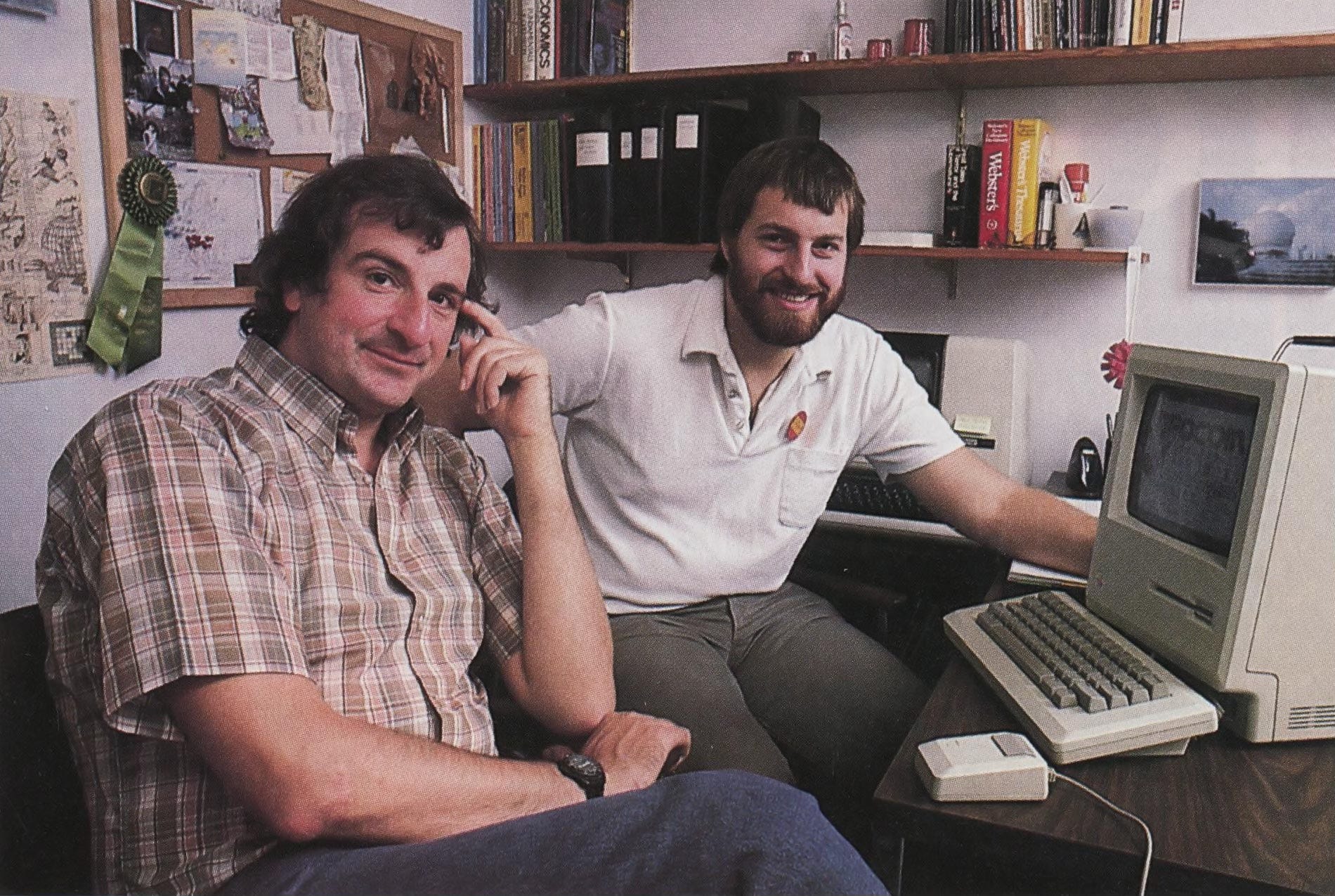
By the time he was in his late twenties, Meretzky had become a standout star within his company and his industry. He was newly married and doing work that gave creative satisfaction. There was plenty for him to be happy about in 1985, but the lopsided Reagan reelection weighed on him. “It was so disheartening,” says Meretzky. “I thought his agenda was horrible in countless ways.”
Trickle down economics was really just a con, a way to transfer money from future generations to a few people in the present day. And at the same time, Reagan was coddling the religious right and eroding the separation of church and state.
“Reagan was creating a huge budget deficit to give tax cuts to the wealthy. Trickle-down economics was really just a con, a way to transfer money from future generations to a few people in the present day. And at the same time, Reagan was coddling the religious right and eroding the separation of church and state.”
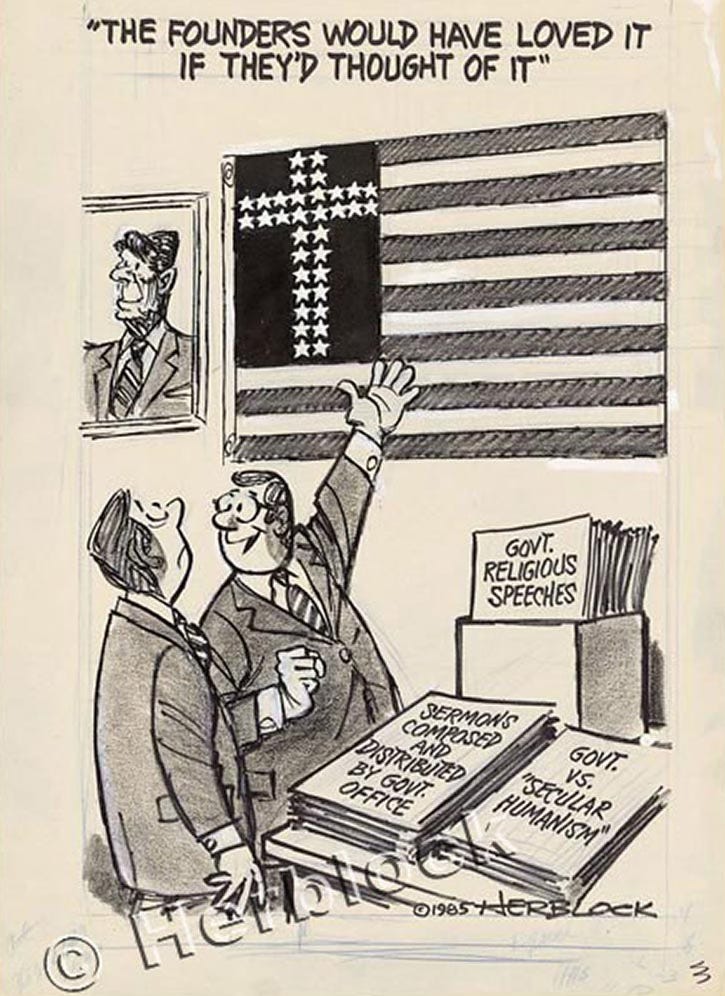
Fresh off the enormous success of Hitchhiker’s Guide, Meretzky began to conceptualize a game with a public policy angle. “I thought, what if I could make people realize the horribleness of Reagan’s policies?” he says. “Text adventures tend to soak up all of your attention, even when you aren’t playing them. Like, you’re driving around town or mowing the lawn, but you’re thinking about a puzzle you can’t beat, or some solution you haven’t tried yet. If the games could do that with puzzles, maybe I could harness interactive fiction to get inside people’s heads and change their minds about political ideas.”
Infocom allowed him to run with the concept, despite its uncommercial nature. “There was discussion internally of whether a game with such a strong political bias was a bad idea,” says Meretzky. “Dave Lebling, who was sort of the office conservative back then, was the biggest defender of it. His take was that someday he might want to write a game with political content, and he didn’t want anyone telling him that he couldn’t.”
As with all Infocom games, you started playing A Mind Forever Voyaging long before you inserted the floppy disc into your computer. The feelies included with Meretzky’s game featured a map of the town of Rockvil, South Dakota, where the bulk of the game takes place.
There are almost 200 different locations you can visit, including a bookshop, a museum, a high school, a liquor store, a Chinese restaurant, a university, a city hall, a zoological garden, an airport, a bar, and a church. “That’s something I’m sort of good at, creating geography,” says Meretzky. “Rockvil is a fictional place, but in a very specific nonfictional location, right on the Little Sioux River.” (The town was named after Meretzky’s wife, Betty Rock.)

Another feelie that came with the game is a 5200-word short story written by Meretzky. It outlines the life of Rockvil resident Perry Simm, tracing his development from age four to age 20. Along the way, it introduces details about the near-future time period—the game is set in the year 2031.
At age 20, when Perry’s life finally seems to be falling into place after a somewhat tumultuous childhood, he faces the biggest existential crisis imaginable: he learns that he’s not really a person. Perry Simm is actually PRISM, an artificial intelligence who’s been living a simulated life inside of a virtual version of Rockvil. PRISM exists within a series of computers at a research facility.
“Imagine yourself in the same circumstance,” Meretzky writes. “You have spent 20 years living a normal, unsuspecting life. You are YOU. Then suddenly, one day, the universe around you is torn away, and you learn that your whole life has been a charade, a carefully calculated scientific experiment. Perhaps, at this very moment, you are a normal human being, sitting in some comfortable armchair reading this story. But – perhaps you are not. Imagine the shock; imagine the terror.”
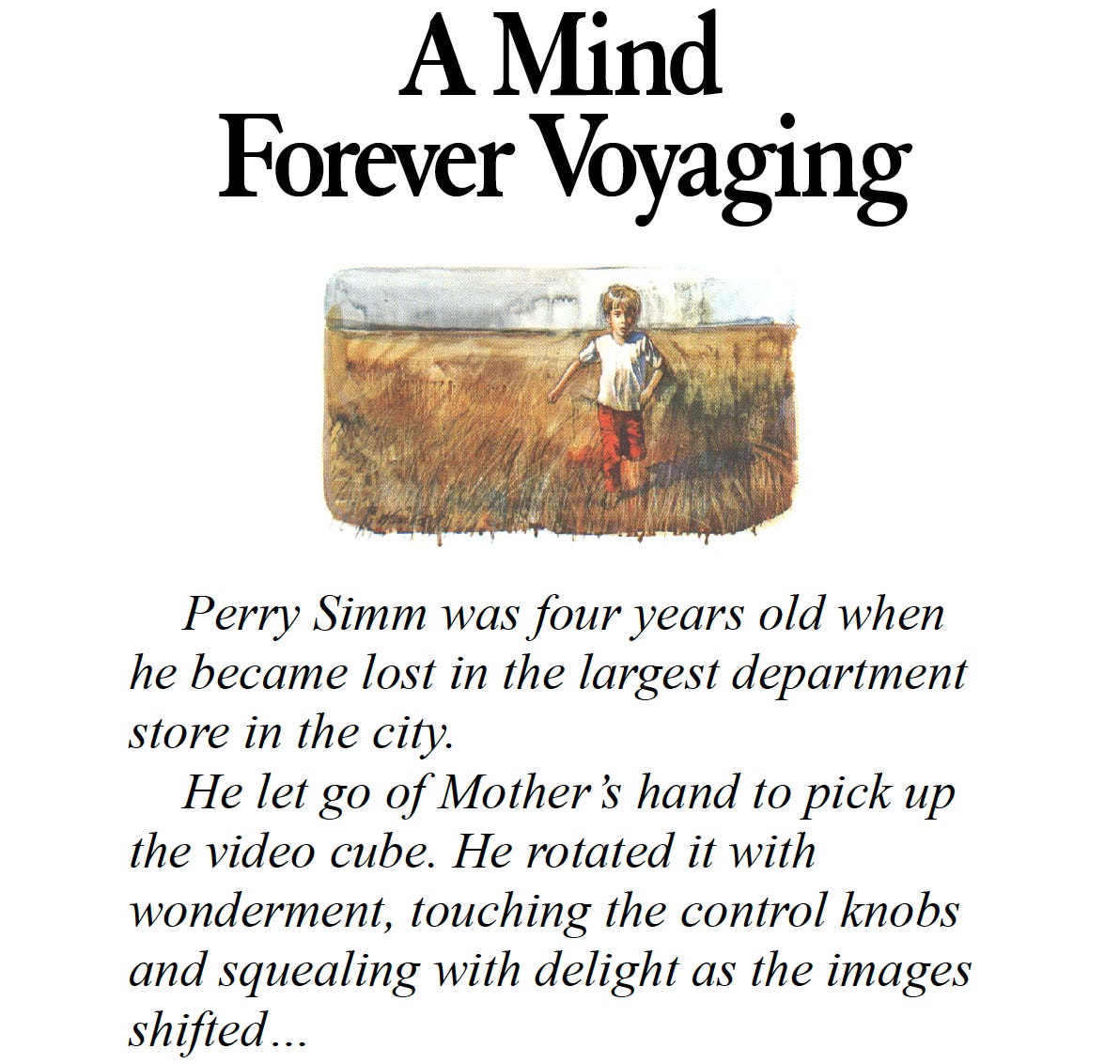
Insert the game disc into your computer, and you learn more about why PRISM/Perry was created. Researchers needed a sophisticated AI that thinks and perceives like a real human in order to allow them to test out possible future scenarios. In particular, they want to simulate the effects of the ambitious political program proposed by a charismatic right-wing populist senator named Richard Ryder. (See what he did there? Richard Ryder = Ronald Reagan.)
Ryder’s sweeping reforms include a 50% cut in tax rates, a massive rollback of regulations and foreign aid, a restrictive trade policy, a concentration of power in the executive branch, and a return to traditional values in education. Scientists program these policies into their simulated version of Rockvil, then let the simulation run until a decade has passed. PRISM will then be able to explore the simulated city as the human Perry Simm, and observe what effects the policies had after 10 years.
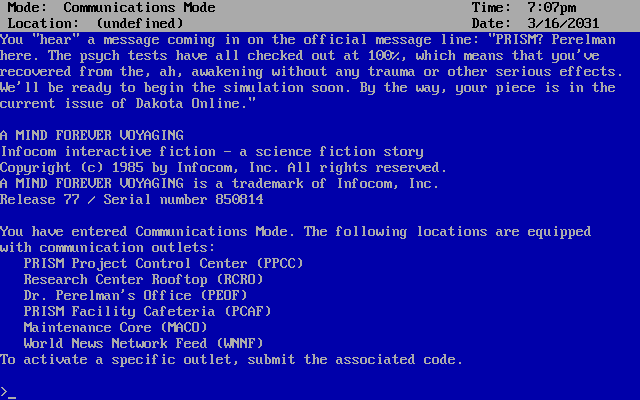
Puzzles are the lifeblood of text adventures, but there are almost no puzzles in A Mind Forever Voyaging. Instead, your goal is to simply notice things. Gameplay is centered around recording events that demonstrate how the city of Rockvil has changed. There are specific tasks assigned to you, but they mostly involve everyday activities—reading a newspaper, going to a movie, eating at a restaurant, visiting a courthouse or a church, riding public transit, or going home to your family. (At this point in his simulated life, Perry has a wife and child.) Once you have provided the scientists with sufficient data, they are able to run the simulation further, and you can visit Rockvil 10 more years into the future. Then 10 more years after that, and so on.
Infrastructure crumbles, poverty skyrockets, airport security becomes ludicrously stringent, and police raids become commonplace. Within a few decades, the town of Rockvil is an Orwellian nightmare.
It’s noteworthy that Meretzky managed to make observing the long-term effects of policy central to the actual gameplay of A Mind Forever Voyaging, because games that riff on real-world events often tend to do so on a surface level. For instance, the classic 1980s arcade brawler Bad Dudes is ostensibly about the two bad dudes rescuing President Ronnie from the clutches of the evil DragonNinja. (Win the game, and Ronnie invites you to join him for a celebratory burger.) With just a few minor tweaks, you could change the story of Bad Dudes to be about two badass Greenpeace activists who rescue Shamu from the clutches of the evil WhalerNinja. But the real subject matter of the game would be the same — you run around kicking and punching scores of henchmen.
A Mind Forever Voyaging required you to get to know the town you live in. The more you explore Rockvil, the more it begins to feel like a real place. And Meretzky allows enough nuance that the changes to Rockvil don’t seem so bad at first. Oh sure, the underprivileged people on the bad side of town seem to be having a hard time, and you hear rumblings about prisons being filled to capacity. But the scientists are initially convinced that the Plan for Renewed National Purpose will prove to be beneficial. And the myalar fashions in the feelies look quite stylish.

.The evidence to the contrary becomes increasingly apparent as your proceed through subsequent iterations of the town. Infrastructure crumbles, poverty skyrockets, airport security becomes ludicrously stringent, and police raids become commonplace. Within a few decades, the town of Rockvil is an Orwellian nightmare. A couple of decades after that, it’s a post-apocalyptic hellscape.
Ultimately, the political message of the game is about as subtle as a jackboot to the skull by a member of the Border Security Force. “There’s no question that it’s polemical, and like all true science fiction, it uses some very outlandish conceits to illustrate and comment upon some very relevant and contemporary issues,” says Whitta.
“As social commentary, the game’s a bit of a mixed bag,” writes Jimmy Maher, a historian of computer games who’s written extensively about A Mind Forever Voyaging on his site The Digital Antiquarian. “It’s at its worst when it merely cribs from classic dystopian literature like 1984, and at its best when it tries to seriously explore the potential ramifications of the Republican positions of its day.”

Still, some of the least subtle moments of the game are among the most memorable. “There’s a scene where Mitchell, your son within the simulation, has joined the church, which at this point has become a cult-like arm of the government,” says Meretzky. “He comes into your home with church police and levels accusations at his mother, your wife, Jill. I’ve heard many people say that this moment was particularly horrifying for them.”
It unfolds like this:
The ten years since you last saw him have left scant change on the face of your son. "Mitchell!" you yell, and take a step toward him, but a blow from one of the cops sends your frail, old body flying against the wall.
“She is the one.” The voice is Mitchell’s, but the tone is cold, unrecognizable, sending shivers through you. “She spake against the Church; she tried to poison the mind of a child too young to know the Truth.” The thugs grab Jill, who reaches toward Mitchell, tears of terror streaming down her face. Totally unresponsive, he turns and walks calmly out of the apartment.
As Jill is dragged, screaming and crying, through the front door, you try to follow, but a cop pummels you in the stomach with his club. You fall to the floor, retching, as the apartment door slams closed, shutting you off forever from the son you cannot understand and the wife you will never see again.
Ultimately, the game has a happy ending. (I won’t spoil it, but reaching it does involve solving a puzzle.) “You manage to singlehandedly defeat and discredit the evil senator who tried to get his policies in place,” says Meretzky. “And when you do, one final simulation becomes available—ten years further into the future, but it’s a good future now. Instead of everything going wrong, everything goes right.” Perry Simm is an elderly man living in a utopia brought about by progressive political policies. War is obsolete, the human lifespan has been extended, crime and poverty are almost nonexistent.
“The ending of the game is a thing of beauty,” says Maher. “It’s a fervently imagined dream for the better world that could be if we would all wake up and start looking forward to a brighter future instead of back to some fabled past.”
Infocom believed that what Meretzky had created was more than just a game—it was a piece of interactive literature. To stress the seriousness of its ambitions, they held a press conference for A Mind Forever Voyaging’s release at the lavishly appointed Trustee’s Room at the New York Public Library. (To underscore how seriously Infocom wanted the game to be taken, an afternoon tea service was provided to the assembled press, complete with “traditional tea cakes, scones, biscuits, etc. … along with tea, coffee, port sherry, and scotch on the rocks--Perrier will be available.”)
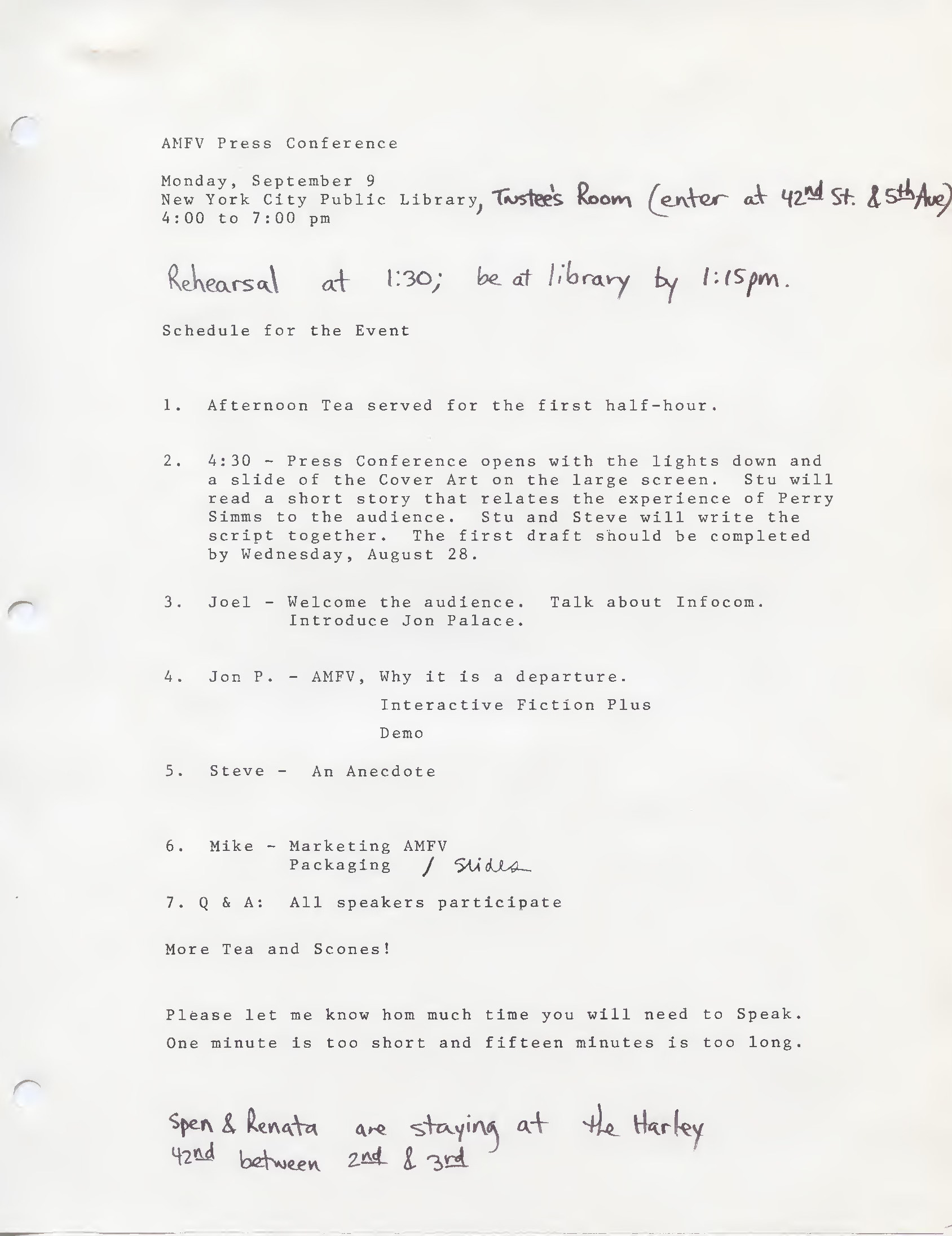
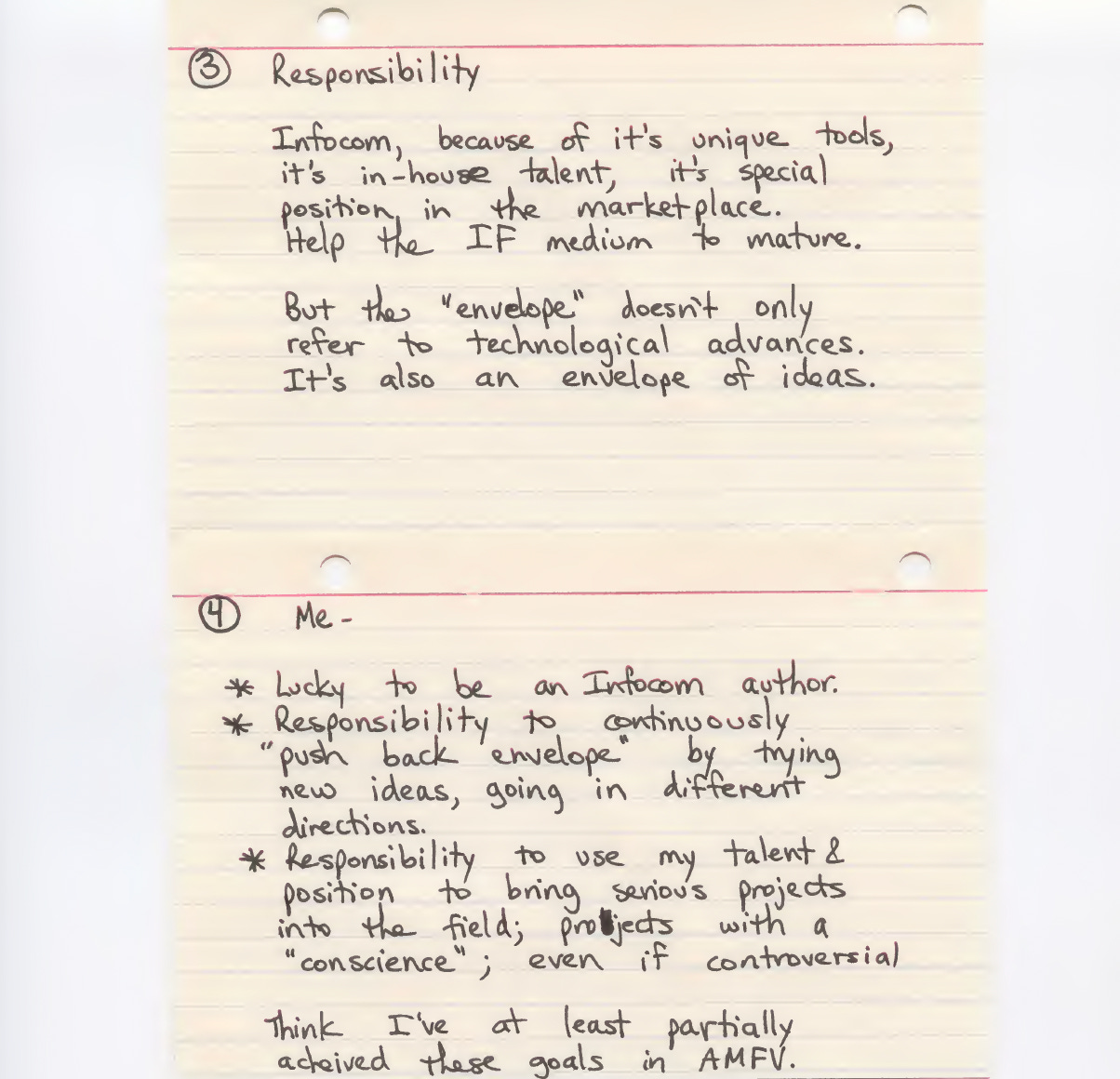
Meretzky preserved the note cards with his prepared talking points for the event. He wrote about not wanting to be typecast after working on the hugely successful comedy game Hitchhiker’s Guide to the Galaxy. He wrote about wanting to push the envelope of what interactive fiction could do, and insisted that it couldn’t simply mean a smoother interface or a larger vocabulary. He believed that Infocom had to push the envelope of ideas and help the medium mature. Meretzky felt he had a:
“responsibility to use my talent & position to bring serious projects into the field; projects with ‘conscience’; even if controversial. I think I’ve at least partially achieved these goals in A Mind Forever Voyaging.”
Meretzky himself desperately wanted to see the game’s pointed message spark some real controversy. “I was hoping I’d get dragged in front of a congressional committee,” he says. But no outcry greeted its release. Apart from a rave writeup in Newsweek, and rapturous notices in some enthusiast magazines, it did not spark much of a reaction at all. “Sales were somewhat disappointing,” says Meretzky. “Fifty thousand was kind of the goal, but it ended up moving thirty or forty thousand.”
The core fanbase for Infocom games was nonplussed with A Mind Forever Voyaging as well. “Many people in our player community did not like the lack of puzzles,” says Meretzky. “They complained that it was too easy, too different, or just not what they wanted.”
The Impact of A Mind Forever Voyaging
It’s impossible to say if Meretzky’s trailblazing game is directly responsible for broadening the possibilities of what interactive entertainment can express. But it’s unmistakably true that it was unheard of in 1985 for a game to offer a sharp political critique, and nowadays it isn’t. Indie games like Disco Elysium and Papers, Please and This War of Mine foreground political systems and ideology. And players regularly debate the social commentary woven into the themes and plotlines in Watch Dogs, Far Cry, Bioshock, and The Last of Us.
It’s easier to see Meretzky’s influence on specific game developers. Sam Barlow, the brilliant creator of games like Telling Lies and Immortality, is a big fan. He gushes about it at length on the podcast My Favourite Game. “It anticipates so many things!” he says. “You have the freedom to go anywhere in this whole simulated city—it has an open world approach to its progression.” The game was clearly an inspiration for Barlow’s award-winning Her Story, in which the progression is also built around exploration and observation.
Gary Whitta encountered the game in his early teens, and was also profoundly influenced by it. “I think of it as a classic not just as a computer game but within the wider pantheon of science fiction,” he says. “So many of Infocom’s games seemed to harken back to a golden age of literary science fiction in their ambition and execution, but AMFV was absolutely the high point for me.”
“As a kid it was probably one of the first really high-level, intellectually stimulating works of true sci-fi I had experienced in any medium,” he adds. “I credit a lot of my own ambition to become a writer to my experience with that game.”
Whitta was so entranced by A Mind Forever Voyaging that he even wrote a film script based on it. “I think part of the appeal was the challenge; like a lot of very heady, high-concept sci-fi novels, it’s not immediately apparent how it would translate from a textual into a visual medium. So I thought it would be a good exercise to take a real crack at it. I reached out to Steve Meretzky for his blessing, and he wound up giving me so much more than that. He sent me his original design notes and diagrams that he had used when creating the game, and eventually gave me notes and feedback on the finished script. I’ll always be grateful to him for that.”
“I’m still fighting to get some kind of screen adaptation going,” says Whitta. “As a piece of socio-political science fiction, I think it’s more relevant now than at any time since it was first created during the Reagan years.”
Some details feel uncomfortably current. In A Mind Forever Voyaging, the Joybooth Manufacturers of North America—whose devices are tied to tens of thousands of youth suicides—align themselves with Ryder’s regime as part of a public relations crusade to protect their business. It’s difficult not to see a parallel in the way today’s tech giants seek favor with political power, even as the societal costs of their platforms mount.

What Meretzky took away from the underperformance of A Mind Forever Voyaging
Meretzky only made one explicitly political game. “I never really tried to do that again,” he says.
For his next release, he decided to instead court controversy a little more brazenly. His next game was a romp called Leather Goddesses of Phobos. It was a highly sexualized sendup of classic sci-fi serials of the 1930s. It pushed the envelope in a different direction, allowing players to opt for Lewd Mode, which featured more profanity and risqué situations.
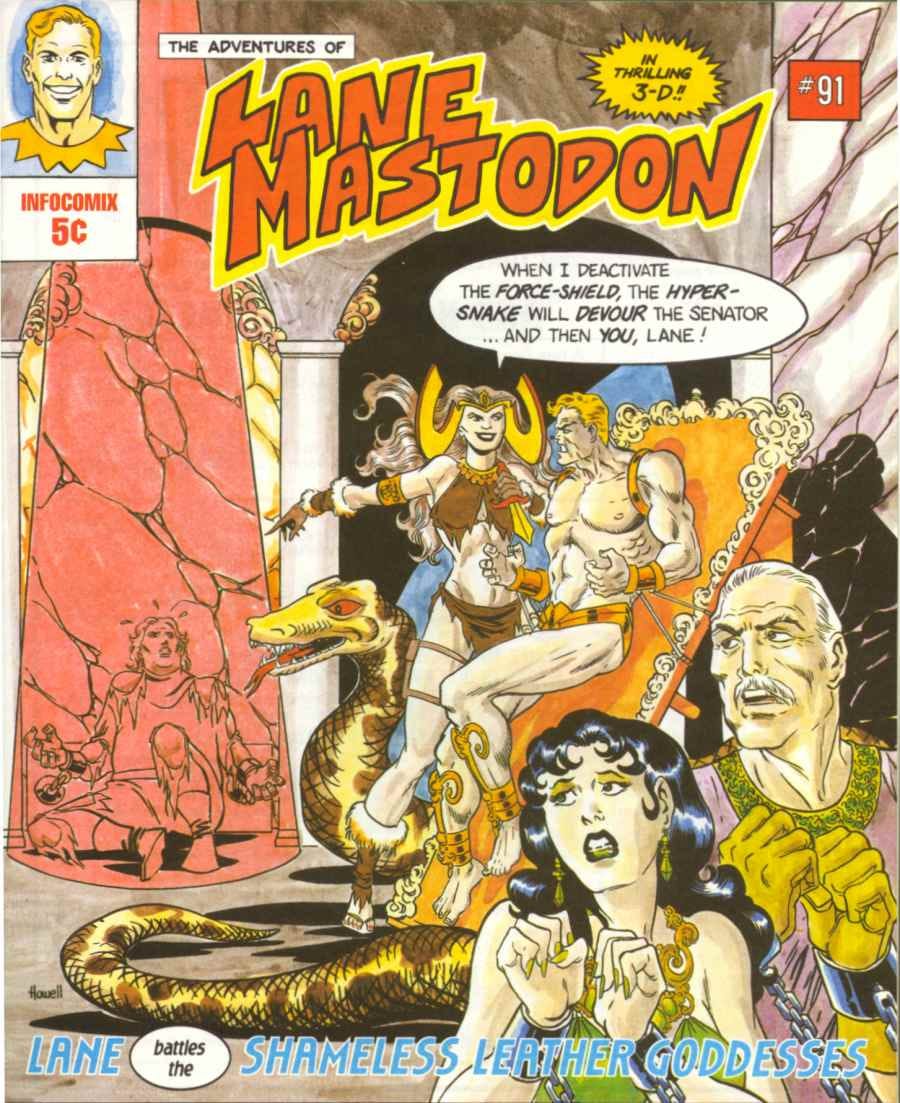
The game was a big hit, selling twice as many copies as A Mind Forever Voyaging. And it’s also seen as a classic and a touchstone by fans of interactive fiction. Meretzky later made a sequel called Leather Goddesses of Phobos 2: Gas Pump Girls Meet the Pulsating Inconvenience from Planet X!
People can’t spend all of their time discussing politics and fighting evil. They are still going to need distractions and downtime. And we provide that. I think that’s a pretty damn important function at any time, but it’s especially important now.
He would go on to make many more acclaimed and popular games, including the Spellcasting 101 series. The protagonist is the young boy Ernie Eaglebeak, who is locked away in the attic by his cruel stepfather until he breaks away and becomes a star pupil at Sorcerer University. (It seems to have served as an inspiration—direct or indirect—for that Hogwarts-based book franchise by She Who Must Not Be Named.)
Meretzky has since worked for game companies like WorldWinner, Playdom/Disney, GSN, and King. He’s currently VP of Design at PeopleFun, which makes popular mobile games like the anagramming puzzle title Wordscapes. He shares his insights about the state of live service games every year on a panel at the Game Developers Conference. (At the latest one, a few weeks ago, he announced his impending retirement and received a standing ovation from his industry peers.)
“It’s interesting,” says Meretzky. “The early part of my career was very focused on games with storytelling and narrative, but the second half has been more about designing game systems and economies. I’ve had several forays back into the core game world, but the majority of the time now, I’m designing stuff aimed at a casual audience.”
He says he’s not interested in pursuing another political game at the moment, even though he feels that the current White House occupant makes Ronald Reagan look like FDR. “So many of the things I was worried about in the 1980s have come to pass,” he says. “All of the warmongering and trickle-down economics produced exactly the sort of results I was afraid of. And the whole Trump thing is massively demoralizing, particularly at my age. The day Obama left office was the peak of what the world will achieve in my lifetime. People certainly won’t repair all of the damage that will be done by the Trump administration before I die.”
It’s a tough time for the games industry, and developers who aren’t struggling to find work are driven to distraction by the state of the world. “What I would say to them is that what we do may seem trifling, but it really is important, particularly at a time when so many people are so dispirited,” says Meretzky. “People can’t spend all of their time discussing politics and fighting evil. They are still going to need distractions and downtime. And we provide that. I think that’s a pretty damn important function at any time, but it’s especially important now.”
POSTSCRIPT
In the course of reposting this 2017 article in 2026, I sent a few follow-up questions to Meretzky. I updated a few quotes in the piece above based on his responses, but here is the full exchange.
Q: What all are you doing these days?
I’m working at PeopleFun, a mobile game studio that specializes in word games. The last game I released was Wordscapes Solitaire, which you can find on both the Apple and Android app stores. It involves clearing tableaus of cards, as in most solitaire games, except that you clear them by making words rather than stacking cards by suit or rank. There’s also an interesting meta-game called the Library of Lost Words, which is essentially a system for collecting tens of thousands of unique words.
Q: I interviewed you about the resonance of AMFV in the early days of Trump’s first term. How do you see the relevance of the game in this current moment, which is somehow even more dire?
In talks that I gave during the presidency of Bush-the-Lesser (2001-2009), I’d talk about how I wrote AMFV to show Reagan as a fanatic-coddling deficit-exploding warmonger, and I was so successful that we’ve never had a president like that since. Always got a good laugh. But of course, having Bush-the-Lesser back now would be a huge improvement, right? So, while I see AMFV as more relevant than ever, I also see my efforts as more useless than ever...
Q: A Mind Forever Voyaging centers on an AI used to simulate political futures. How does that premise feel now, with the rise of generative AI?
In the backstory that accompanies the game in the AMFV package, I deal with the issue of creating artificial consciousness; how scientists had created computers with far more power than a human mind, yet had never achieved consciousness or self-awareness, and how that was finally achieved with PRISM by “raising” the artificial intelligence just like an infant, mirroring the experiences of a human baby through to adulthood. So here we are, with massively capable AI, but still no consciousness in sight or any clear theories on what might achieve that.
Q) You’ve had tremendous hits, and games like AMFV that are widely viewed as underappreciated masterpieces and milestones that inspired other groundbreaking designers. Any thoughts on the value of the former versus the latter?
Better both than one or the other! But better either one than working on a game for a year or more only to have it killed, and no one other than perhaps a smattering of testers ever sees it, which is just a heartbreak.
Q) I quote you saying games can be a welcome relief in dark times. Where are you seeking relief these days?
My weekly board game group is a big help. Also scotch. Actually, those two things are often paired. Also, late night comedy shows — Daily Show, Kimmel, Colbert, Seth Meyers... And being able to participate in things like “No Kings” marches is a great outlet. It’s always great to see the enormous turnout and know that millions still care about what’s going on.
READ MORE:
Meretzky has released his archives from the development of A Mind Forever Voyaging and you can dig through nearly five hundred pages of his notes, code, press clips, and other material at Archive.org.
Sean J. Jordan’s newsletter The Greatest Games You (Probably) Never Played has several posts that explore Meretzky’s career. One gives an overview of his Infocom games, one is a deep dive on two humorous sci-fi text adventures, and another explores some of his interesting post-Infocom work from the 1990s.
Aaron A. Reed’s project 50 Years of Text Games and the accompanying book are absolutely worth your time, and the lengthy essay on A Mind Forever Voyaging is particularly good.
The Digital Antiquarian published an excellent three-part deep dive into A Mind Forever Voyaging that starts here.
The 2010 documentary Get Lamp by the inimitable tech historian Jason Scott is a fantastic overview of the past and future of interactive fiction, and Meretzky is a central figure in it. The game designer also makes a cameo in MC Frontalot’s epochal music video celebration of text adventures “It is Pitch Dark” around the 3:30 mark. (Thanks Sean J. Jordan for the reminder.)
When I worked at Wired magazine, we did a feature where we asked a bunch of great science fiction writers for their six-word stories, in the manner of Hemingway’s famous “For sale: baby shoes, never worn.” I made sure that we reached out to Meretzky. He submitted several options, all of which were absolute bangers. You can see every participant’s six-word stories here, but Steve’s contributions are all below.
Wasted day. Wasted life. Dessert, please.
He read his obituary with confusion.
Leia: “Baby’s yours.” Luke: “Bad news…”
I win lottery. Sun goes nova.
Time traveler’s thought: “What’s the password?”
Parallel universe. Bush, destitute, joins army.
Dorothy: “Fuck it, I’ll stay here.”
Steve ignores editor’s word limit and
I'm a simple man. I see anything connected to an Infocom game, I upvote.
Still have it on my shelf.